AI for Product Feedback: Triage Without Losing Control

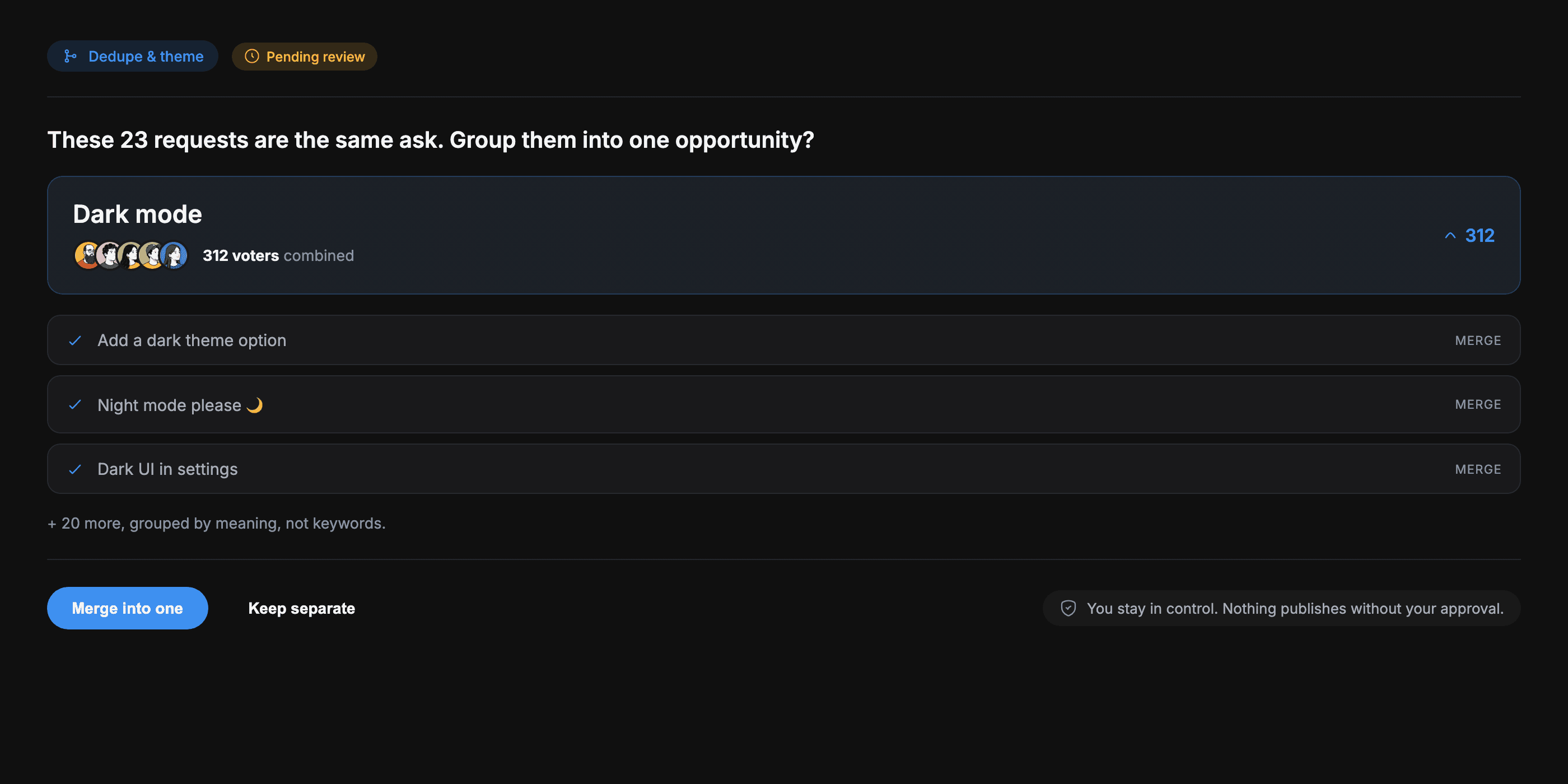
AI for product feedback works best as a fast assistant that clusters requests and drafts summaries, not as an autopilot that decides what you build. Used well, it turns a messy inbox of duplicate requests into a short list of clear opportunities you can act on. Used badly, it publishes things you never approved and quietly buries the context that told you why a request mattered. This guide draws the line.
What AI is good at in feedback triage
Feedback triage is repetitive, high-volume, and pattern-heavy. That is exactly the shape of work AI handles well. The point is to remove grunt work from a human, not to remove the human.
Deduping and theming
The single most useful job is collapsing near-duplicates. Fifty people describe the same missing export button in fifty different phrasings. A model reads them all and groups them, so you review one theme instead of fifty tickets. This is where the loop starts: many similar requests become one opportunity you can put on a roadmap.
Drafting, not deciding
AI is good at first drafts you will edit: a theme title, a two-line summary of what a cluster is asking for, a starter set of tasks for an accepted opportunity, or a changelog entry once work ships. Each of these saves you the blank-page problem. None of them should go out untouched.
- Cluster similar requests and name the theme
- Summarize a group of requests in plain language
- Suggest a rough priority signal (volume, recency) for you to weigh
- Scaffold starter tasks from an accepted roadmap item
- Draft a changelog entry when the work is done
What AI should never do on its own
The failures here are not subtle. They happen when a tool is allowed to take an irreversible or judgment-heavy action without a person in the loop.
- Auto-publish anything public. A changelog entry, a roadmap change, or a status update reaches real customers. A person approves before it ships.
- Decide priorities alone. Volume is a signal, not a verdict. One request from a strategic account can outweigh twenty from casual users, and only you know that.
- Close or dismiss feedback silently. If a request gets merged or archived, a human should stand behind that call.
- Email your customers automatically. Notifications go out on your say-so, tied to work you actually shipped.
AI drafts. Humans approve. That order is the whole discipline.
Guardrails that keep you in control
Good guardrails are boring and enforced by the tool, not by your willpower on a busy day. Four of them matter most.
Human approval on every public action
Treat AI output as a pull request against your product, not a merge. It should land in a draft or review state that a person clears. If a workflow lets a model publish without a click from you, that is a workflow to change.
Never send customer PII to the model
Your feedback contains emails and names, especially from account-less submitters. The model does not need them to cluster requests or draft copy. Send it the text of the request; keep the personal data out. Deduping works on what people wrote, not on who they are.
Scope to one workspace
AI should only ever see and act on one project's feedback at a time. Cross-tenant leakage is both a privacy problem and a correctness problem: a model that mixes two products' requests will invent themes that make sense in neither. Keep the boundary strict.
Avoid the firehose
Do not run AI over everything on every change. Batch it, cap each run, and require at least a couple of real requests before a theme is allowed to form. A model that clusters aggressively will happily force unrelated items together. Restraint produces themes you trust.
How Feedock draws the line
Feedock is built so the human stays in charge by default. When you run theme detection, the AI clusters un-themed feedback and proposes a title and summary for each group, but every cluster is a draft. You Accept a theme (it becomes a private roadmap item with the underlying requests linked, so you keep the 'who asked' trail) or you Dismiss it (the items become available to cluster again). Nothing goes public in that step.

From an accepted opportunity, AI can scaffold three to six starter tasks that you review and deselect before they are created. When work ships, it can draft a changelog entry, but publishing is a separate, human action that then emails the people who asked. The model never receives end users' email addresses, and every AI run is scoped to the one project you are working in and gated to owners and admins. The pattern is the same everywhere: AI removes the busywork, you make the call.
A simple workflow to adopt
- Let AI cluster incoming feedback into themes once you have enough volume to see patterns.
- Review each theme; accept the ones that are real opportunities and dismiss the noise.
- Weigh priority yourself using volume as one input among several.
- Accept an opportunity onto your roadmap and let AI scaffold starter tasks you trim.
- Ship the work, review the drafted changelog, and publish it yourself so the right people get notified.
FAQ
Can AI prioritize product feedback for me?
It can surface signals like request volume and recency, which help you decide faster. It should not set priorities on its own, because priority depends on context (strategy, customer value, effort) that lives outside the feedback text.
Is it safe to send customer feedback to an AI model?
The request text is generally fine to process; the personal data attached to it is not. A well-designed system sends the model what people wrote and keeps emails and names out, so no customer PII reaches the model.
Will AI publish updates to my customers automatically?
It should not. In Feedock, AI drafts changelog entries and theme summaries, but a human approves and publishes every public update, and only then are voters and subscribers notified.
AI for product feedback earns its place when it drafts the tedious parts and hands you the decisions. That is how Feedock is built: from feedback to shipped, in one workspace, with you in control at every public step. start free and see the loop run on your own feedback.