Building in Public: A Playbook for Solo Founders

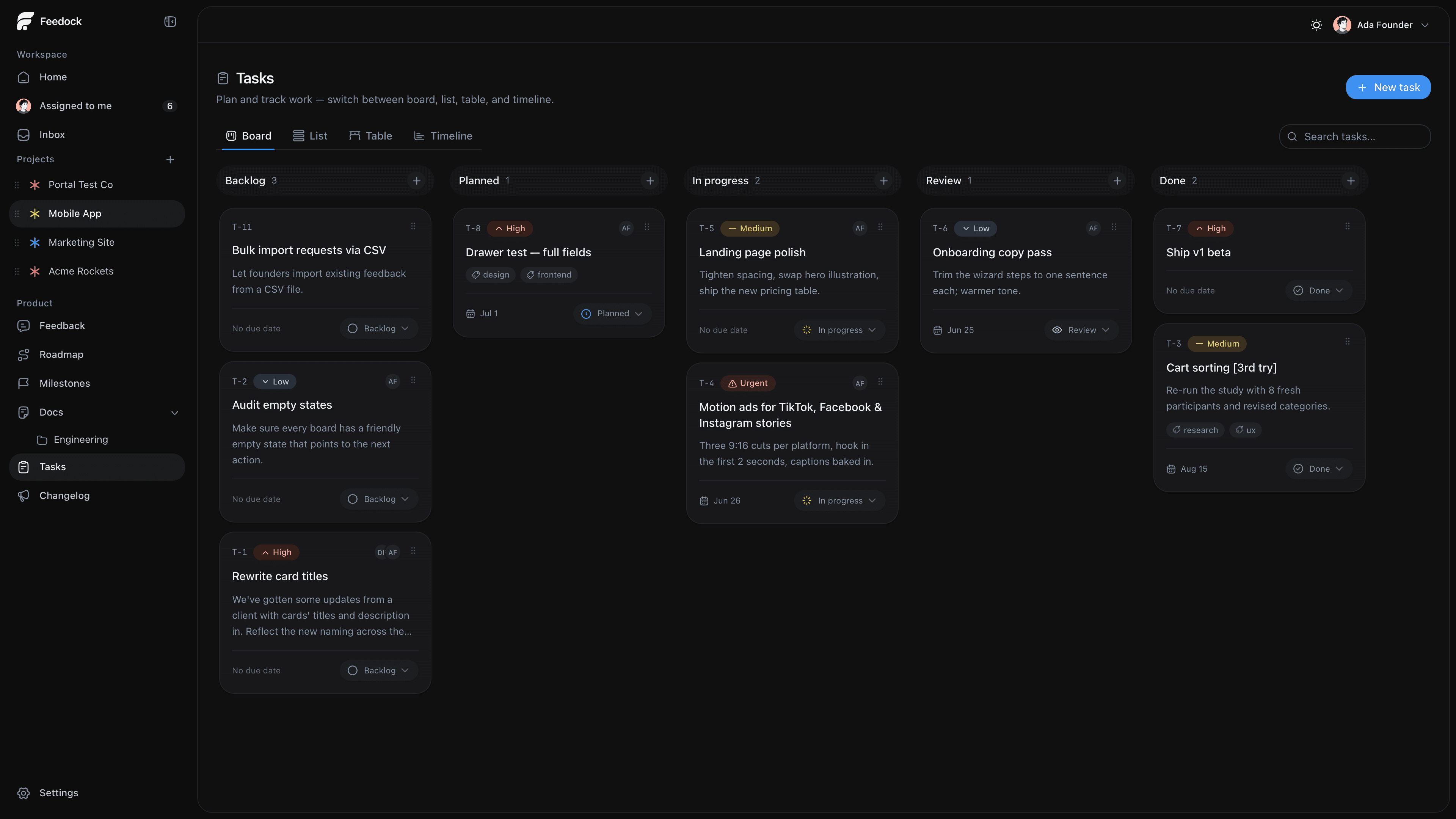
Building in public means shipping where people can see it: sharing what you are working on, what you decided against, and what just went live, out in the open instead of behind a closed door. Done well, it turns your roadmap and changelog into a distribution channel and a trust layer at the same time. Done badly, it becomes a stream of noise that burns you out and tells your competitors your plans. This playbook is about doing it well, and doing it at a pace you can keep.
What building in public actually means
Building in public is not live-tweeting every keystroke. It is a deliberate practice of showing the work: the problems you are solving, the tradeoffs you are making, and the progress you are booking. The audience is not only potential customers. It is also the people who already asked for something and want to know if you listened.
There are two honest reasons it works for a solo founder or a tiny team:
- Trust compounds. When people can watch you take feedback, plan it, and ship it, they stop wondering whether you are a real product with a real pulse.
- Attention is cheap when the work is the content. You do not need a content calendar full of invented topics. The roadmap moving and the changelog updating are the posts.
You are trading a small amount of privacy for a large amount of credibility. The trick is controlling exactly how much you trade, and where.
Why a public roadmap and changelog do the heavy lifting
Threads and posts are ephemeral. A public roadmap and a changelog are durable surfaces that keep working after you close the tab. They are the two artifacts that carry the most weight for the least ongoing effort.
The roadmap sets expectations
A simple public roadmap, split into Now, Next, Later, and Shipped, answers the three questions every prospect and every existing user is quietly asking: are you working on the thing I care about, is it coming soon, and are you actually shipping. You do not need to commit to dates. You need to show direction and momentum.
The changelog proves you deliver
A changelog is receipts. Every published entry is evidence that a request became real work and then became a shipped thing. Over a few months, the changelog becomes the single most persuasive page you own, because it is a track record instead of a promise. Tie each entry back to the feedback that prompted it and the story writes itself: someone asked, you built it, here it is.
A roadmap is what you say you will do. A changelog is what you actually did. Prospects trust the second one.
Sharing progress without oversharing
The fastest way to quit building in public is to feel like you have exposed too much. So set the boundary on purpose. Not everything needs to be public, and the good tools let you decide item by item.
A workable split for most solo founders and small teams:
- Public: the roadmap items you are comfortable committing direction to, shipped features, and the changelog. This is the trust layer.
- Private: internal tasks, half-formed specs, revenue numbers you would rather not post, security work, and anything customer-specific. This is the workshop, and workshops are allowed to be messy.
- Your call, per item: early ideas. Some you float publicly to gather votes. Others you keep private until you have decided they are worth doing.
The principle is simple: share outcomes and direction freely, keep the raw internals private, and never make oversharing the default. A per-item public/private toggle is what turns building in public from an all-or-nothing gamble into a dial you control.
Close the loop: tell the people who asked
Here is the step most founders skip, and it is the one that pays the most. When you ship something, go back and tell the specific people who requested it. Not a broadcast to everyone. A note to the person who typed the request months ago.
That single email does three things at once:
- It rewards the person for giving you feedback, so they give you more.
- It turns a shipped feature into a reason to come back and use the product.
- It signals, more convincingly than any marketing copy, that feedback here is not a black hole.
For this to be sustainable, the connection between a request and a shipped update has to be tracked automatically. If you are copying names into an email by hand, you will stop doing it by week three. The loop only survives if the notification is a byproduct of publishing, not a separate chore.
How Feedock turns the loop into a distribution channel
This is where a purpose-built workspace earns its place. Most feedback tools stop at collecting requests and drawing a roadmap. The execution, the tasks and milestones and the actual code, lives somewhere else, so the loop breaks in the middle. Feedock keeps the whole chain in one place, which is the difference: feedback becomes shipped work without switching tools.
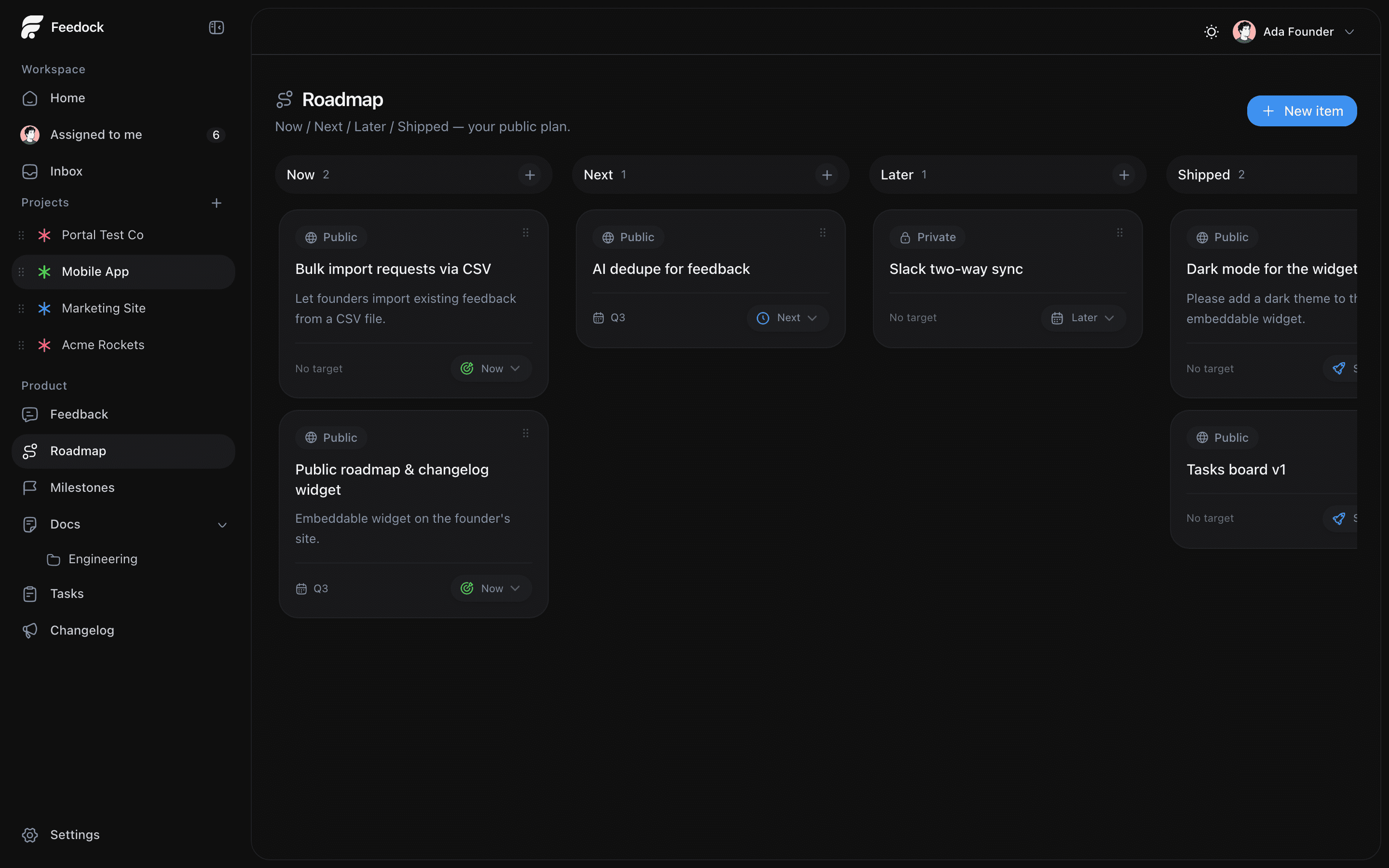
Concretely, here is the loop running end to end:
- End users submit and vote on feedback with just an email, verified by a magic link. No account required, so you actually hear from people. The AI clusters similar requests so twenty variations of the same ask become one opportunity, and a human decides what to do with it.
- You accept an opportunity onto the public roadmap (Now / Next / Later / Shipped), and Feedock can scaffold the starter tasks for you. You review and edit them; the AI only drafts.
- Your GitHub, GitLab, Bitbucket, or Gitea activity moves those tasks forward automatically as PRs and commits land, and milestone progress derives itself.
- When it ships, the AI drafts a changelog entry. You approve and publish. Publishing emails the exact voters who asked, plus your subscribers, and updates the public surfaces.
- Those public surfaces embed three ways: a hosted portal, a React SDK, or a one-line widget on your own site. The update shows up where your users already are.
Two things worth being clear about, because they are the point. Every AI step drafts and a human always approves before anything publishes. And the AI never receives end users' email addresses. You get automation on the boring parts (deduping, scaffolding, drafting) while the judgment and the publish button stay with you.
A cadence you can actually keep
Consistency beats intensity. A founder who posts a real update every week for a year will out-build-in-public a founder who posts ten times in a burst and then vanishes. Design a rhythm that survives a bad week.
- Weekly: publish at least one changelog entry, even a small one. Small and steady reads as alive; silence reads as dead.
- Weekly or biweekly: move one or two items on the public roadmap so the direction visibly updates.
- Monthly: review the feedback board, cluster what came in, and promote the clearest opportunity to Next.
- As it happens: when something ships that people asked for, let the publish step notify them. That one is automatic, so it costs you nothing to keep.
The reason to route this through a single workspace is that the cadence stops depending on your discipline. Publishing an entry is the same action that notifies voters and updates the widget. You do the work once, and the distribution happens as a side effect.
Frequently asked questions
Is building in public worth it for a solo founder with no audience yet?
Yes, and starting early is the advantage. You are not building an audience so much as building a track record, and a public changelog is worth having on day one so that when someone does find you, there is proof you ship. The audience follows the receipts, not the other way around.
How do I build in public without giving competitors my roadmap?
Share direction, not detailed plans, and keep the specifics private. A public roadmap item can say what problem you are tackling without exposing how or exactly when. Keep tasks, specs, and anything sensitive behind a private toggle. Competitors seeing that you listen to users is a feature, not a leak.
What is the difference between Feedock and a feedback tool like Featurebase or Canny?
Those tools live in the feedback, roadmap, and changelog category and do it well. The difference with Feedock is that execution is built in: tasks, milestones, and progress driven by your actual Git activity live in the same workspace, so a request becomes shipped work without exporting it to a separate project tool. The loop stays intact from feedback to shipped.
Building in public is not a marketing stunt you bolt on later. It is a loop: listen, plan in the open, ship, and tell the people who asked. Put that loop in one workspace and it turns into a distribution channel that runs while you build. start free and let your changelog do the talking.