Feature Request Management for Tiny Teams: A Simple Guide

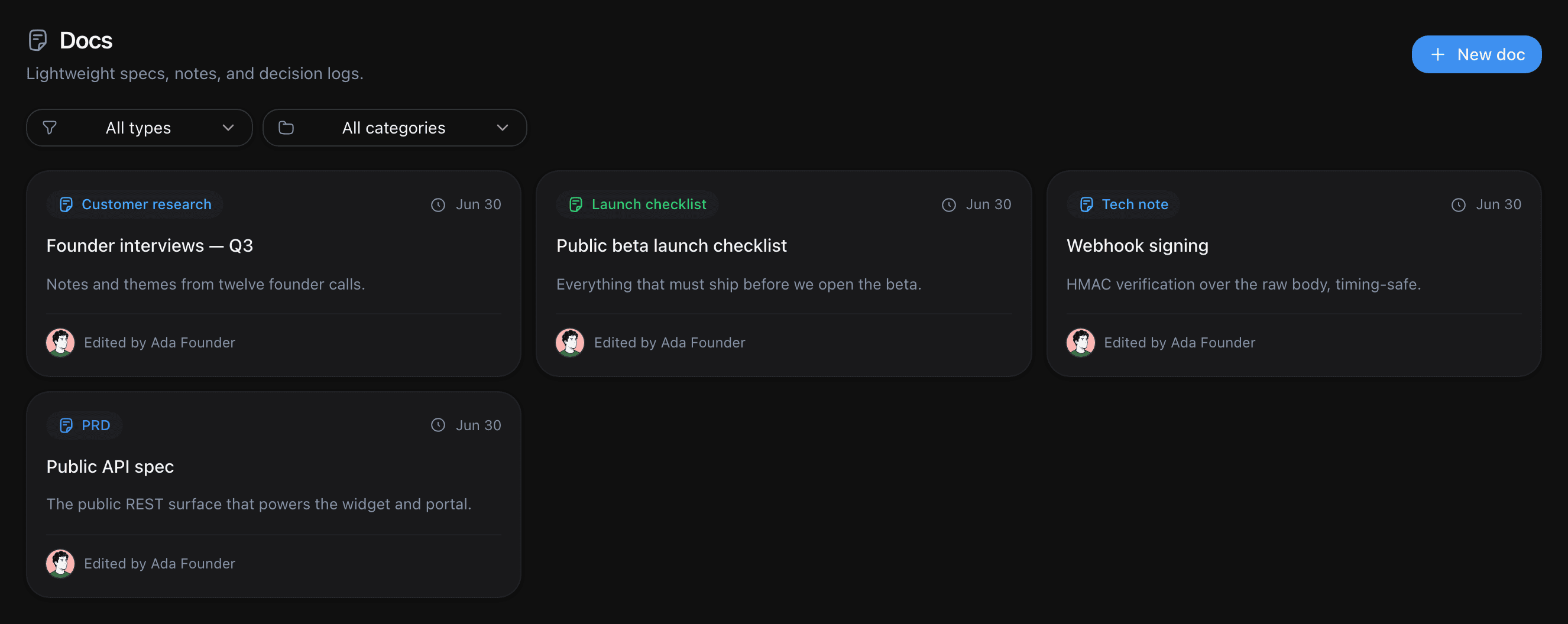
Feature request management does not have to mean a wall of tickets, custom fields, and a weekly grooming meeting. For a solo founder or a team of two to five, it means one clear answer to a simple question: what did people ask for, and did we actually ship it? This guide walks through a five-step system built for tiny teams, with no heavy process, and shows how the whole thing can run end to end in one place.
Why tiny teams need a lighter approach
The tools most people reach for were built for different problems. Jira and Linear are execution systems for engineering orgs. Featurebase, Canny, Nolt, and Frill are feedback and roadmap hubs. Both categories are good at what they do, but neither hands a small team the full path from a raw request to a shipped, announced change. You end up copying requests from one tool into another by hand, and the person who asked never hears back.
A heavy setup fails tiny teams in a specific way: it adds work that only pays off at scale. Custom workflows, story points, and approval chains are overhead when the whole product team fits in one thread. The goal is not more structure. The goal is a short, honest loop you can actually keep running while you build.
- Jira-heavy: many statuses, required fields, sprint ceremonies, and a process someone has to maintain. Powerful for large orgs, friction for a team of three.
- Lightweight: capture in one click, one place to prioritize, a public roadmap the person who asked can see, and an automatic note back to them when it ships.
- The test: if managing the requests costs more time than acting on them, the system is too heavy.
The five steps of a simple system
Every workable feature request management system, no matter how small, does five things in order. Get these right and you do not need anything else.
1. Capture without friction
Requests arrive from everywhere: support emails, a Discord message, a call, a tweet. If capturing them is a chore, they get lost. You want one place users can post to directly, and one place you can drop the ones that come in sideways.
- Let end users submit and vote themselves, so you are not the bottleneck. Requiring them to create an account kills most of that input.
- Account-less submission (just an email, verified by a magic link) keeps the barrier low while still giving you a real person to notify later.
- Capture the request in the user's own words. You can clean it up when you triage, not before.
2. Deduplicate so signal is not buried
The same idea shows up ten different ways. If each lands as its own item, your board looks busy and tells you nothing. Merging duplicates is what turns a pile of requests into a ranked list of real demand. Twenty similar asks should read as one strong opportunity, with the vote count to prove it.
- Merge near-identical requests so votes and voters fold onto a single canonical item.
- Preserve who asked. When you merge, you should not lose the people, because they are exactly who you notify at the end.
- This is where AI earns its place: grouping similar requests into one theme is tedious to do by hand and easy to automate, as a draft you approve.
3. Prioritize with the smallest useful signal
You do not need a scoring model with six weighted inputs. For a tiny team, vote count plus a quick read on effort covers most decisions. The point of prioritization is to pick the next few things, not to rank all fifty.
- Sort by demand (votes and requesters) to see what most people want.
- Weigh it against your own read of effort and fit. You are the founder; your judgment is a valid input.
- Move the winners onto a public roadmap in plain buckets: Now, Next, Later, Shipped. That is enough structure for a small team and it doubles as a promise to your users.
4. Convert a request into real work
This is the step most feedback tools skip, and it is where requests go to die. A roadmap item is a promise; it is not work. Someone still has to turn it into tasks, do them, and track progress. If that happens in a separate tool, the link between the request and the work breaks, and nobody can tell you the status of what a user asked for.
- Break the roadmap item into internal tasks with a simple flow: Backlog, Planned, In Progress, Review, Done.
- Group related work under a milestone so progress is visible without a manual status update.
- Let your existing git activity move the work forward. A merged pull request should be able to push its linked task to Done on its own, so the board reflects reality instead of your memory.
5. Close the loop
Shipping is not the end. The people who asked still do not know it is done. Closing the loop means telling them, and it is the step with the biggest payoff in the whole system: it converts a fixed bug into a loyal user and gives you something to post publicly. Skip it and you are quietly training people that requests go nowhere.
- Write a short changelog entry: what changed, why it matters.
- Notify the voters and requesters who asked for exactly that thing.
- Update the public roadmap and any embedded widget so anyone watching sees the progress, which is free build-in-public momentum.
How Feedock runs this end to end
Feedock exists because those five steps usually live in five different tools. It keeps them in one workspace, so a request becomes shipped work without any copy-paste between apps.
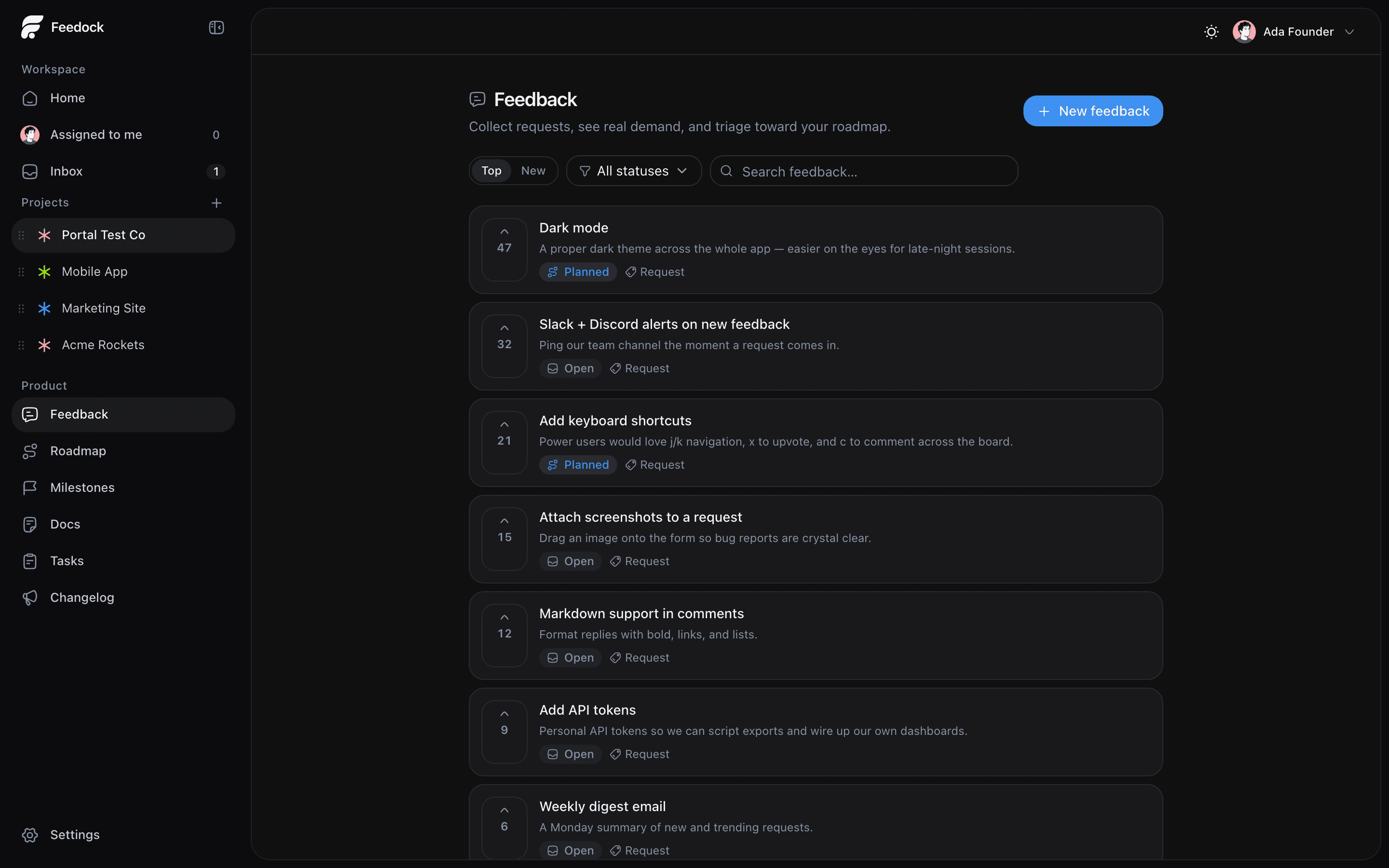
- Capture: an account-less feedback board. End users submit, vote, and comment with just an email verified by a magic link. No account, low friction.
- Deduplicate: AI theme clustering drafts groups of similar requests (many asks into one opportunity) and you approve them. AI never receives end users' email addresses.
- Prioritize: vote and requester counts sit on each item, and accepted opportunities move onto a Now / Next / Later / Shipped public roadmap.
- Convert: a roadmap item links to a milestone and tasks; AI can scaffold the starter tasks for you to review, and GitHub, GitLab, Bitbucket, or Gitea activity moves tasks along as PRs merge.
- Close the loop: publish a changelog entry (AI drafts, a human approves and publishes) and the voters who asked get emailed automatically. The public portal, React SDK, and one-line widget update on your own site.
The difference is not any single feature. It is that execution is built in, so feedback becomes shipped work in the same place you collected it, and the person who asked hears back without you remembering to tell them.
A feature request is not managed until the person who asked knows it shipped.
Frequently asked questions
What is feature request management?
It is the process of collecting user requests, removing duplicates, deciding what to build, turning the winners into real work, and telling the people who asked once it ships. For a small team, the whole thing should be lightweight enough to keep running while you build.
Do I need Jira or Linear for this?
Not for a team of two to five. Those tools are execution systems built for larger engineering orgs, and their process becomes overhead at small scale. A lighter system that connects feedback directly to tasks and a public roadmap covers what a tiny team actually needs.
How do I handle duplicate feature requests?
Merge them so votes and voters fold onto one canonical item, which shows the true level of demand. Keep the list of who asked, because those are the exact people you notify when the feature ships.
You can run all five steps, from a raw request to a notified voter, in one workspace instead of five. start free and turn your next feature request into shipped work.