How to Prioritize Your Product Roadmap (Small Teams)

When you prioritize your product roadmap as a small team, the hard part is not building the list. It is choosing what to ignore. Every request feels urgent, every customer sounds important, and every idea has a case for going first. This guide gives you a lightweight way to sort real signal from noise without turning planning into a second job.
Why prioritization breaks for small teams
Big product orgs have dedicated PMs, quarterly planning cycles, and scoring spreadsheets nobody enjoys maintaining. You have a backlog, a handful of loud customers, and about two hours a week to think about direction. Heavy frameworks assume time and people you do not have.
The usual failure modes are familiar. You build whatever the last person emailed about. You chase the biggest logo instead of the biggest pattern. Or you freeze, because with no clear signal, every option looks equally defensible. None of these are a strategy. They are just different ways of letting urgency decide for you.
The fix is not a better spreadsheet. It is a small set of honest signals you can read at a glance, then trust enough to say no.
The four signals that matter
You do not need ten inputs. Four lightweight signals cover most decisions a tiny team faces. Read them together, not in isolation, and let them argue with each other.
1. Demand: how many people asked
The simplest signal is raw demand. How many people upvoted or requested this? Ten requests for the same thing is a pattern. One request, however well argued, is an anecdote. Vote counts on a feedback board turn scattered emails and support tickets into a number you can rank.
Demand is not the whole story, but it is the cheapest to gather and the hardest to argue with. Start here.
2. Who asked: customer weight
Not every vote counts the same. A request from a paying customer on your best plan carries more weight than one from a free trial that churned last week. Two questions sharpen this:
- Are the people asking the customers you want more of?
- Would shipping this keep an at-risk account, or win one you have been chasing?
Demand tells you how many. Customer weight tells you which ones. A feature with fewer votes from exactly the right people can beat a popular request from the wrong crowd.
3. Impact vs effort
For each candidate, estimate two things roughly: how much difference it makes, and how long it takes to build. You do not need precise numbers. A three-way split (small, medium, large) on each axis is enough to spot the obvious wins.
- High impact, low effort: do these first, always.
- High impact, high effort: schedule deliberately, break into milestones.
- Low impact, low effort: batch as quick wins between bigger work.
- Low impact, high effort: cut, or park until the case changes.
The trap here is treating your first effort estimate as fact. It is a guess. Revisit it once you actually start scoping, and let it change your ranking.
4. Strategic fit
The last signal overrides the other three when it needs to. Does this move you toward the product you are trying to build, or is it a well-liked detour? A popular request that pulls you off course is still a distraction. Sometimes the right call is to say: real demand, good customers, reasonable effort, and still no, because it is not what we are here to build.
Signals inform the decision. They do not make it. A roadmap is a set of bets, and betting is your job.
A simple prioritization pass, start to finish
Here is a repeatable loop you can run in under an hour, most of it reading rather than debating.
- Pull your top candidates by demand. Sort the feedback board by votes and take the top ten to fifteen. Ignore the long tail for now.
- Tag who asked. Note which requests come from the customers you want more of. Weight those up.
- Do a fast impact-vs-effort read. Bucket each into the four quadrants above. This is minutes, not a workshop.
- Apply the strategic filter. Cross off anything that does not fit where the product is going, no matter how popular.
- Pick the next few, not the next twenty. Commit to a short Now, a lighter Next, and let Later stay vague. A roadmap that plans six months in detail is fiction.
- Ship, then re-read the signals. Demand shifts as you ship. Rerun the pass on a cadence you can sustain, not a calendar someone told you to follow.
The bigger risk: over-process
The most common mistake small teams make is not picking the wrong feature. It is building so much process around the decision that the process becomes the work. A weighted scoring model with eight criteria and decimal points looks rigorous. For a two-person team, it is theater. It gives false confidence and eats the time you should spend shipping.
Your prioritization system should be light enough to run in your head on a good day and in a single view on a bad one. If reading your signals takes longer than acting on them, you have too much machinery. Cut it back until the decision is fast again.
Trust rough numbers, ship, and correct with real usage. That beats a precise plan you never revisit.
How Feedock grounds prioritization in real signal
Feedock is built so the signals above sit in one place instead of scattered across a spreadsheet, an inbox, and three support threads. The point is to make prioritization something you read, not something you assemble.
- Demand is visible on every item. The feedback board shows vote counts, so ranking by real interest is a sort, not a research project. End users vote with just an email, verified by magic link, no account required, so the count reflects actual demand rather than who bothered to sign up.
- "X people asked" travels with the work. When feedback becomes a roadmap item, Feedock keeps the who-asked rollup attached, so you always see how much real demand sits behind a plan entry, on the board and on the public roadmap.
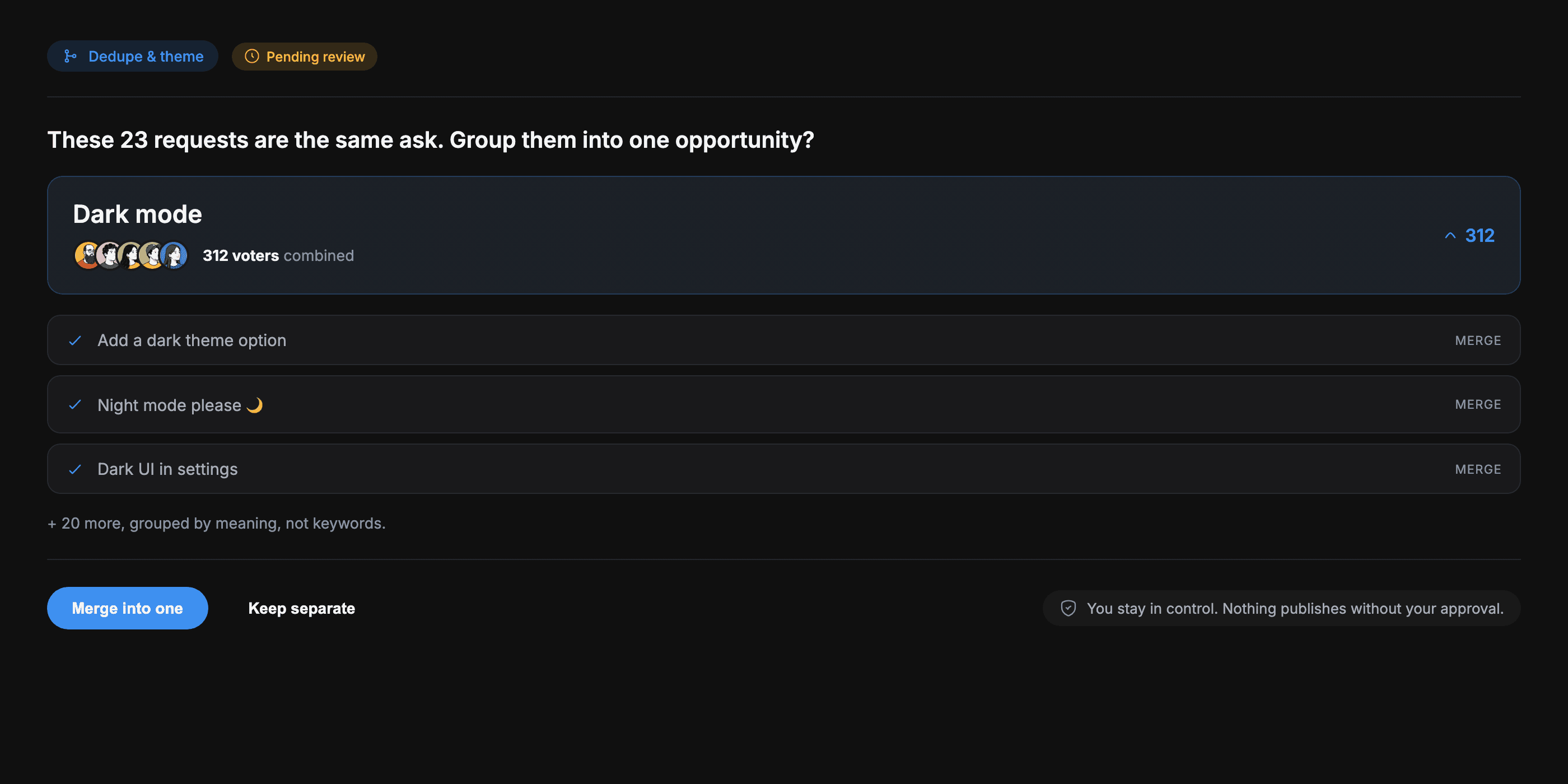
- AI groups the noise for you. Feedock's dedupe drafts turn twenty similar requests into one opportunity, so you prioritize themes instead of re-reading the same ask fifteen times. The AI drafts; you approve. It never sees end users' email addresses.
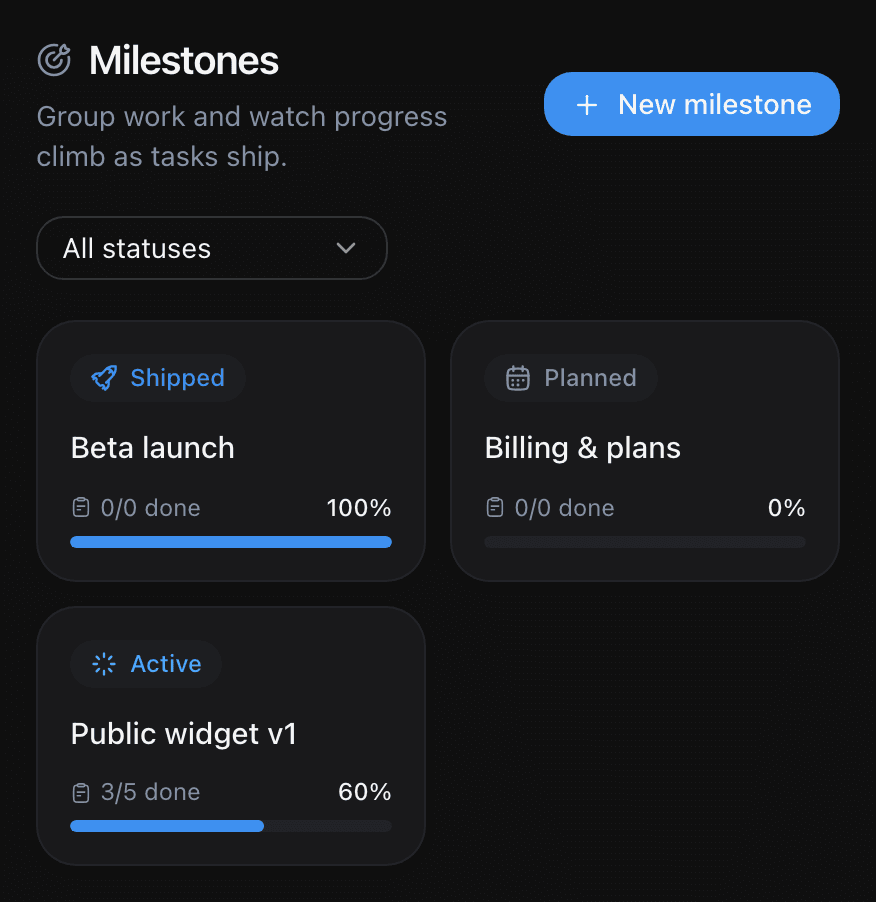
- The decision leads straight to execution. Once you pick something, it becomes a roadmap item, then a milestone with tasks (which AI can scaffold as a draft you approve), and GitHub, GitLab, Bitbucket, or Gitea activity moves those tasks forward. When it ships, the people who asked get notified. Feedback becomes shipped work in one workspace instead of two disconnected tools.
You still make the call. Feedock just makes sure the call is grounded in what people actually asked for, then carries that decision all the way to shipped.
Frequently asked questions
How often should a small team reprioritize the roadmap?
Often enough that new demand gets reflected, rarely enough that you are not planning instead of building. A light weekly glance at top-voted feedback plus a proper pass every two to four weeks works for most tiny teams. Reprioritize when the signals move, not on a fixed ritual.
Should I always build the most-requested feature first?
No. Demand is one signal of four. A heavily requested feature that does not fit your product direction, or that comes from customers you are not trying to keep, can still lose to a lower-vote item with stronger strategic fit. Read demand alongside who asked, impact vs effort, and fit.
What is the lightest prioritization framework for a solo founder?
Sort by votes, weight for who asked, do a quick impact-vs-effort gut check, then apply a strategic filter. That is the whole thing. If a framework needs a spreadsheet you dread opening, it is too heavy for a team of one.
Prioritizing a product roadmap does not require a heavier process. It requires signals you trust and the discipline to act on the few that matter. Put demand, who asked, impact, effort, and fit in one view, then decide. Ready to see your feedback ranked by real demand and carried straight through to shipped? start free.